To accurately answer the question, we first must understand the term "racism". Racism, by its simplest definition, is the belief that race is the primary determinant of human traits and capacities and that racial differences produce an inherent superiority of a particular race.
This is not a belief held by Indian Tribes, nor is it referenced to in the definition of ICWA. In fact, ICWA begins by clearly stating that the intent of the law is to ensure security and stability to Tribes and Children of the Tribes, as well as respecting the continued existence of cultural and social standards of the tribes. It is, therefore, a policy protecting the culture of Natives in America.
To summarize this short argument, before moving forward, it is necessary to reiterate the important fact that maintaining tribal integrity is NOT racist - it is a means of cultural survival.
Why is cultural survival important? Aren't all Indians the same? And shouldn't Indians simply give up and join the "American Culture"?
Now we are at the heart of this discussion. Let's start by answering the above questions in reverse order, and then we will be prepared to truly understand the importance of cultural survival.
The "American Culture", historically, has been one of a "gold rush" mentality - take what you can, as fast as you can, in order to achieve success - often times failing to regard the broader impact of their actions... Quality of life and future generations are second tier to individual achievement. The American Culture can be summed up, socially, as an agrarian society which became an industrial powerhouse - a focus on family interests, sporting and other social events, which as of late has become a society of consumerism and reality television - one would argue that this, in itself, is the erosion of classic American Culture. Should Indian Tribes give up reservations and become "American", giving up the memory of their individual culture? No more than should European Americans stop celebrating Oktoberfest, Halloween, or give up agrarian rituals, like summer vacation from schools... The call for further "Americanization" of the tribes is little more than a call to eliminate the reservations and complete the land-grab that began hundreds of years ago, and to eliminate the memory of the original inhabitants of this land - ancestors to many of my readers (and myself).
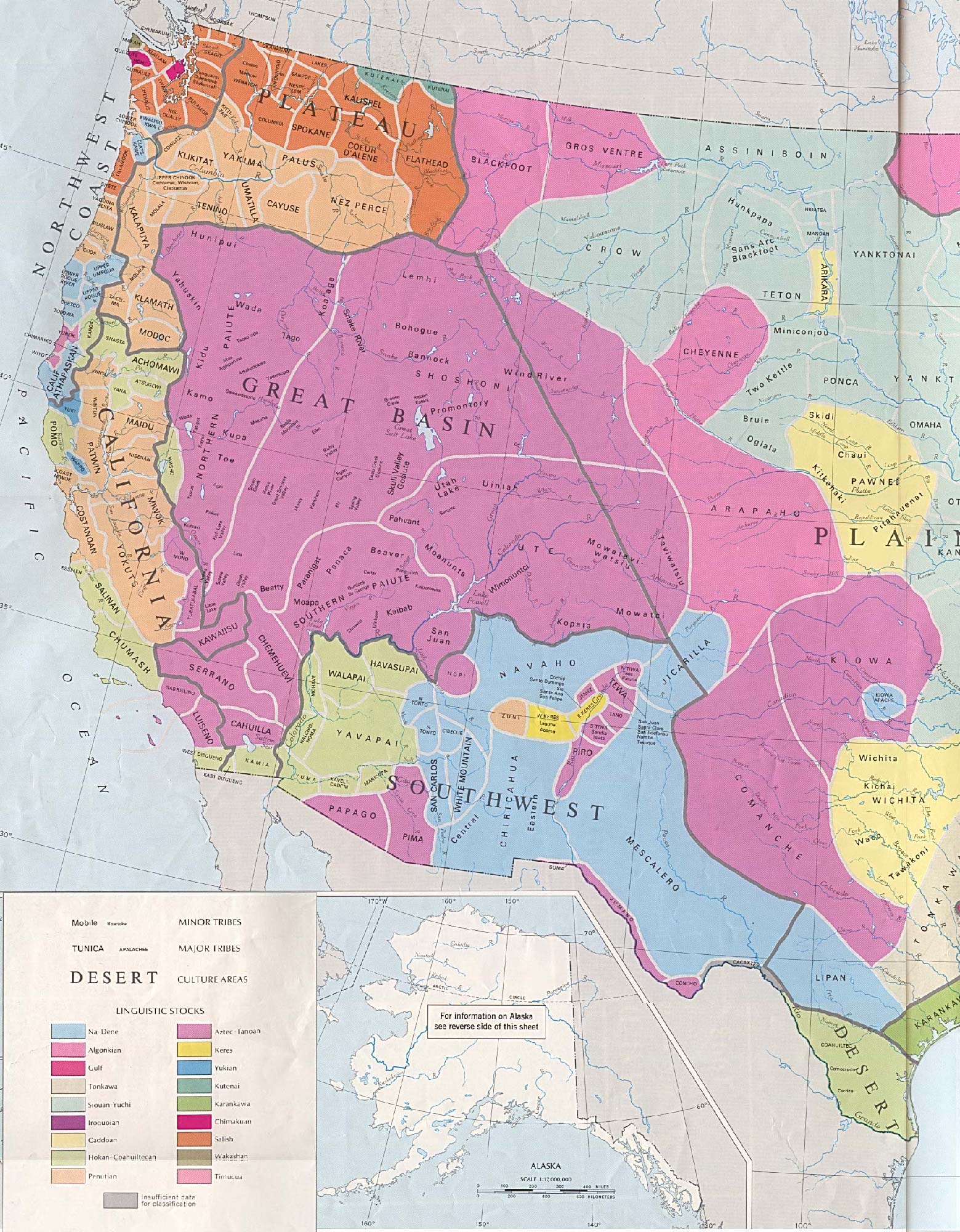
To answer the question about similarity between all Indian Tribes, one need look no further than a language stock map for original inhabitants, or reference any study on tribal culture to understand that though there are basic elements inherent to the nomadic or tribal lifestyle, each tribe of Indians is culturally unique. In fact, some tribes held no more than 50-100 members when they were "discovered" by white explorers, and had no ties to larger regional dominating tribes. Though similarities existed, regionally, it was out of necessity to survive in the lands - for instance, Plains Tribes, such as Oglala, where a nomadic hunting tribe, using housing styles and hunting tactics necessitated by the need to make rapid relocation of their village in order to stay near their migrating food supply. In comparison, Northwestern tribes, such as the Makah or Snoqualmie, were largely stationary and built permanent Longhouses where large portions of the tribes would live, and maintained diets largely from foraging and constant fish runs on the many rivers (or whales - in the case of the Makah). Language, lifestyle, societal structures, and even religion all varied from tribe to tribe, and from region to region... it would take years of study to fully grasp the complexities of each tribe, region, and culture - stressing the importance of passing these subtleties on to children of the tribe.
 Which brings us to the final point - the importance of cultural survival. Michael Savage, a radio commentator, often says that there are three elements necessary to ensure a society succeeds - borders, language, culture. The borders have been stolen long ago from the Indian Tribes, replaced with reservations meant to "Americanize" Indians into an agrarian society - whose land reserves were arbitrarily reduced through a succession of court orders and illegal laws in order to establish homesteading across the nation.
Native Languages have been nearly lost for Indians, as part of the Americanization Era and Policy towards Indians in the late 19th and early 20th centuries. In fact, the 1868 Fort Laramie Treaty included a mandate for White teachers to teach English to Sioux children. As can be seen from the following map, even in areas of large Indian populations, by and large, language has been eradicated amongst those who still live within the reservations:

Special exception can be seen in areas of the Navajo/Hopi Nation, where 14-65% can speak their native tongue, and areas of Crow, Cheyenne, and Sioux reservations where 14-40% speak their native tongue... sadly, across America, native languages have been eliminated.
Finally, and most importantly - Culture. With the variations in Indian culture being as vast as the number of tribes, it is most certainly and fundamentally important that tribal culture be maintained and passed from generation to generation. It is the culture that defines who you are as a group, as an entity, as a people - and to lose that identity is to lose an important part of yourself. Rituals, art, music, clothing, even philosophy - it is all culturally relevant, and once lost, can never be fully regained. The importance of this culture is recognized in the ICWA, as the driving force behind the law's legitimacy... it is also the reason for Total Immersion teaching by tribes in the island nations, and being introduced by the Oglala Sioux on the Pine Ridge Reservation. The Congress was 100% correct in the ICWA document when they stated: "there is no resource that is more vital to the continued existence and integrity of Indian tribes than their children"...
In conclusion, the Indian Child Welfare Act is not a racist law prohibiting whites from adopting Indian children, rather, a thoughtful protection of the integrity of Indian Culture in America. It is a document recognizing the most vital resource to ensuring a continuation of tribal culture, and protecting the future of that culture. When a culture is in threat of extinction, lingually, artistically, or otherwise, it should be the will of the people to protect and preserve... that is the intent of this law - not as an obstacle or punishment to adopting families, but as a protection of a treasure at risk of being lost forever.